How to Swim Faster Without Swimming More: The Triathlete’s Technique Guide
Most age-group triathletes believe the only way to swim faster is to swim more. More metres, more sessions, more time staring at the black line. But volume alone rarely unlocks meaningful speed. Technique, pacing, and deliberate practice are what separate swimmers who plateau from those who keep improving — and all three are available without a single extra session per week.
1. Fix Your Catch Before Everything Else
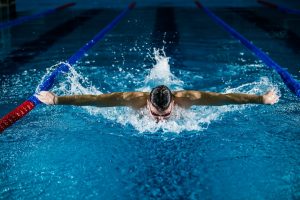
The catch — the moment your hand engages the water to generate propulsion — is where most age-group triathletes lose the most speed. A dropped elbow or a pressing-down action means you’re pushing water down rather than back. Use fist drills, sculling sets, and high-elbow catch drills in your warm-ups. Swim paddles for short sets (4–6 × 100m) amplify your hand’s surface area, making technique errors immediately apparent through feel.
2. Learn Your CSS Pace and Train at It
CSS (Critical Swim Speed) is the threshold pace you can sustain over 400–1500m. Once you know it, every interval session can be built around it. Training at CSS produces far more adaptation per session than grinding out easy lengths. To find your CSS: run a 400m time trial and a 200m time trial on separate days, then calculate: (400m time in seconds − 200m time in seconds) ÷ 200 = your CSS per 100m. Build your main sets around this number.
3. Reduce Drag Rather Than Just Adding Power
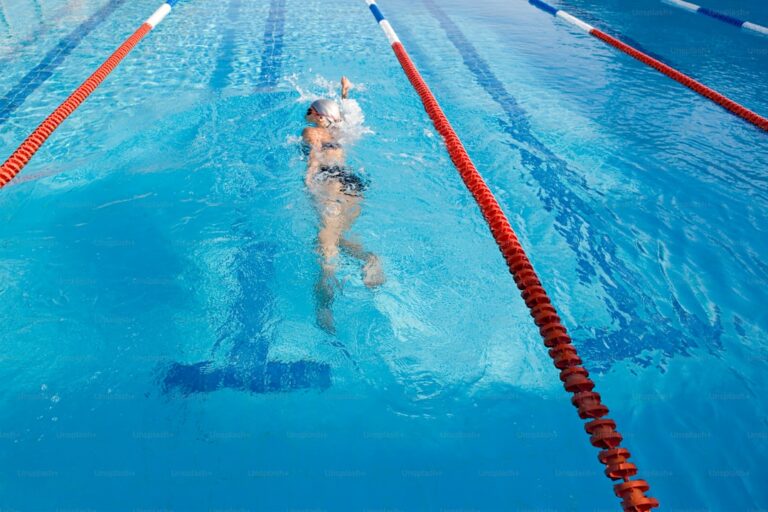
Swimming speed equals propulsion minus drag. Most triathletes work on pulling harder but ignore hydrodynamics entirely. Keeping your hips high, maintaining a still head position, and pressing gently on your chest during the catch can each be worth 5–10 seconds per 100m. Streamlining tightly off every wall adds a free 0.5–1 second per length — 40 seconds over a 1500m pool swim.
4. Practise Bilateral Breathing
Breathing to only one side creates body rotation imbalances, a curved swim line, and extra drag — particularly in open water. Practising three-stroke bilateral breathing during warm-ups and easy sets builds a more symmetrical stroke. In races you may revert to your dominant side under pressure, but the bilateral foundation keeps your technique balanced even at two-stroke breathing intervals.
5. Train Negative Splits, Not Just Fitness
Most triathletes go out too hard in the swim and fade. Negative splitting — covering the second half faster than the first — is a learnable skill that saves energy for the bike. In training, descend your 200s and 400s: start controlled, build through each rep. In races, hold back for the first 200–400m. This alone can improve your T1 arrival condition by 30–60 seconds and reduce the heart rate spike that costs you early on the bike.
Where to Start This Week
Try the CSS Main Set 12×100m or the High Elbow Catch Drills Session — both are built on quality-over-quantity principles and embed these techniques directly into structured workouts.