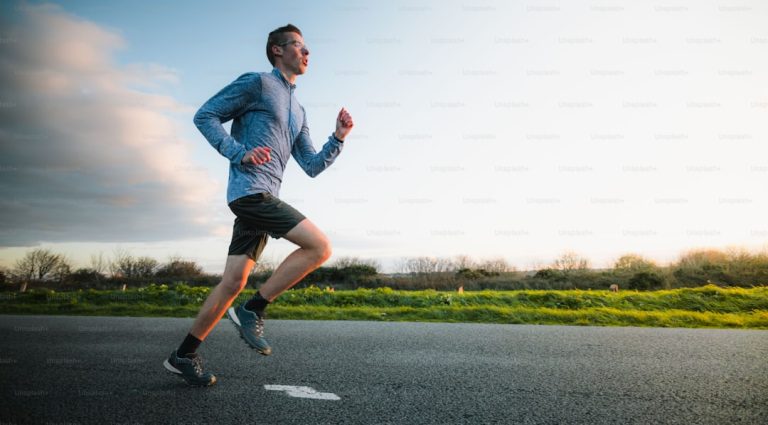
How to Use RPE (Perceived Exertion) in Triathlon Training
Rate of Perceived Exertion (RPE) is one of the most underrated training tools available — and it requires zero equipment. While power meters and heart rate monitors provide objective data, RPE trains you to listen to your body: a skill that pays dividends on race day when technology fails, conditions change, and no metric tells you what to do. Here’s how to use RPE effectively in your triathlon training.
What Is RPE?
Rate of Perceived Exertion is a subjective effort scale — typically scored from 1–10 — that measures how hard your body feels like it’s working. A 1 is virtually effortless (resting); a 10 is maximal, all-out effort that cannot be sustained for more than seconds. Most triathlon training sits between RPE 3–9, with race-specific work targeting RPE 7–9.
The Triathlete’s RPE Scale
- RPE 1–2: Recovery effort — easy spinning or walking. Can talk freely in full sentences.
- RPE 3–4: Aerobic Zone 2 — comfortable and sustainable. Can hold a conversation, breathing is steady.
- RPE 5–6: Moderate aerobic — tempo base work. Sentences become shorter; breathing is audible but controlled.
- RPE 7: Threshold — the intensity you could sustain for 60 minutes if pressed. A few words possible, you’re clearly working.
- RPE 8: Hard interval effort — CSS swimming pace, FTP cycling, track intervals. Only single words possible.
- RPE 9: Very hard — race start surges, 400m track repeats at max. Conversation is impossible.
- RPE 10: Absolute maximum — 10-second sprint, all-out effort. Sustainable for only seconds.
When to Use RPE Instead of Metrics
- Hot weather training — heart rate rises disproportionately in heat and humidity. RPE keeps your effort honest when your HR is 15–20 beats higher than normal at the same absolute pace.
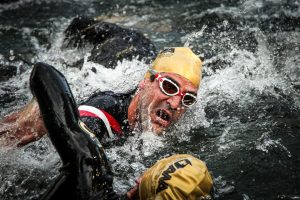
- Open water swimming — GPS pace data is unreliable in open water due to non-linear swims and turns. RPE is the only reliable pacing tool for race-effort open water sets.
- Race day technology failure — watch failure, dead battery, lost GPS signal. Athletes trained in RPE adapt; those reliant purely on data often panic or collapse their pacing strategy.
- Recovery sessions — RPE is the best guard against going too hard on easy days. If you need objective metrics to keep you slow, your body’s signals aren’t being respected.
How to Calibrate Your RPE
RPE accuracy grows with deliberate practice. After every session, record your perceived effort alongside your objective data (power, pace, heart rate). Over time, you build a precise internal map of what each effort level feels like across swimming, cycling, and running. A classic calibration method: after completing a 20-minute bike FTP test, your average perceived effort should sit at exactly RPE 8. If you rate it lower, you went too easy; higher, too hard. Repeat this cross-check regularly to keep your internal calibration sharp.
RPE in Practice: A Weekly Example
- Monday recovery swim: RPE 3–4 throughout. If it feels like more, slow down regardless of what your watch says.
- Tuesday threshold run: RPE 7–8 for intervals. Use pace or heart rate as a guide, but let RPE override if conditions are very hot or you’re carrying residual fatigue.
- Saturday long ride: RPE 4–5 for the majority of the ride. RPE is your main check against going too hard on long aerobic days when power creep is easy to miss.