How to Choose the Right Gear Ratio for Hilly Triathlon Bike Courses
Turning up to a hilly bike course with the same gearing you use for a flat sprint triathlon is one of the more avoidable ways to blow up your run. Gear ratio — the relationship between your chainring and cassette sizes — determines how hard you have to push on every climb, and getting it right matters more for triathletes than for pure cyclists, because every watt spent grinding up a hill is a watt you don’t have for the run leg.
What Gear Ratio Actually Means
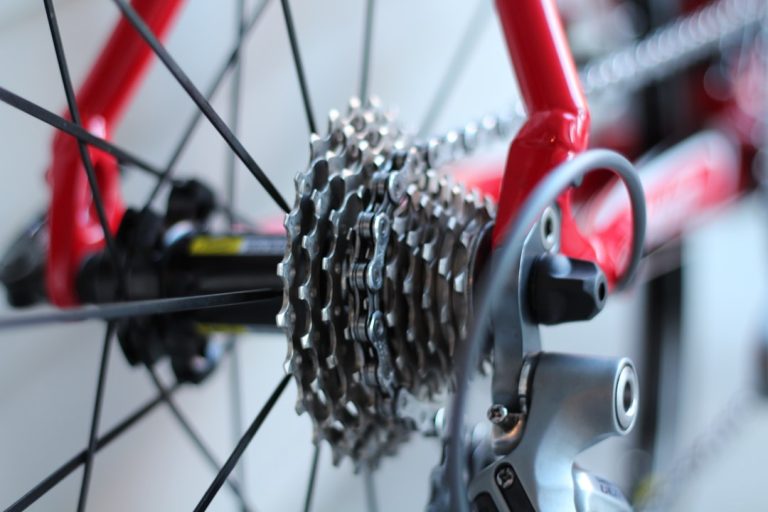
Your gear ratio is simply chainring teeth divided by cassette teeth — a 50-tooth chainring paired with a 25-tooth cog gives a 2:1 ratio, meaning your rear wheel turns twice for every pedal revolution. A lower ratio (smaller chainring, bigger cassette cog) makes climbing easier at the cost of top speed on the flat; a higher ratio does the reverse. For hilly courses, the number that matters most is your lowest available ratio — the “granny gear” you drop into on the steepest sections.
Standard vs Compact vs Sub-Compact Chainsets
- Standard (53/39) — Built for flat, fast racing. On a genuinely hilly course this leaves most age-group triathletes grinding at a low cadence on climbs, which fatigues the exact leg muscles you need fresh for the run.
- Compact (50/34) — The sensible default for most triathletes. Enough range on the big ring for flat sections and fast descents, with a 34-tooth small ring that makes sustained climbing manageable at a reasonable cadence.
- Sub-compact (48/31 or similar) — Worth considering if your race course includes sustained double-digit gradients. The smaller inner ring keeps cadence higher and heart rate more controlled on long climbs, at a small cost to top-end speed you’re unlikely to use in a triathlon anyway.
Don’t Forget the Cassette
Chainring choice only tells half the story — your cassette’s largest cog matters just as much. An 11-28 cassette paired with a compact chainset gives a usable low gear for rolling terrain; if your course has sustained climbs over 8-10%, an 11-30 or 11-32 cassette (check your rear derailleur’s max-cog rating first) gives you meaningfully more room to spin rather than grind. Most modern groupsets accommodate a wide-range cassette without changing the derailleur, but always check the manufacturer’s compatibility chart before buying.
Why This Matters More for Triathletes Than Cyclists
A standalone cyclist can afford to grind up a climb in a slightly-too-high gear because there’s no run afterwards. A triathlete can’t. Climbing in a gear that’s too tall spikes your heart rate, recruits more fast-twitch muscle fibre than a sustainable effort should, and leaves lactate in your legs that takes miles of the run to clear. Gearing down slightly earlier than feels necessary, and spinning a higher cadence up climbs, is one of the simplest changes you can make to protect your run split on a hilly course.
Practical Steps
- Check the course elevation profile and total climbing before race day — a compact chainset with an 11-30 cassette covers the vast majority of UK triathlon courses comfortably.
- Practise your race gearing on a hilly training ride beforehand — don’t discover your gear range is wrong for the first time on race morning.
- If you’re between a compact and sub-compact, err towards the easier gearing — the cost of spinning slightly too easy on a flat section is far smaller than the cost of grinding up a climb in a gear that’s too hard.