Sports Bras and Kit Fit for Women in Triathlon: A Practical Guide
The run leg is where poor bra support gets punished hardest — you’re already fatigued from the swim and bike, and every stride compounds hours of accumulated movement rather than starting fresh. Getting this right isn’t a minor comfort issue; research links inadequate support to real physical consequences, and getting it wrong on race day can wreck an otherwise good performance.
What the Research Actually Shows
Breast movement during running is three-dimensional — not just up and down, but side to side and front to back — and studies have measured several inches of movement during high-impact activity with inadequate support. Sustained, poorly supported movement over time can strain the Cooper’s ligaments that provide structural support, and research has linked greater breast support to reduced movement and less exercise-related breast pain. Support level should scale with both activity intensity and bust size — a bra rated for yoga isn’t rated for a 10km run off the bike.
Compression vs Encapsulation
- Compression bras press breast tissue against the chest wall as a single mass. They tend to suit smaller busts and lower-to-moderate impact activity.
- Encapsulation bras support each breast individually with moulded cups, similar to a conventional bra. They generally offer better support for larger busts and higher-impact activity like running.
- Some high-impact sports bras combine both approaches — encapsulation cups plus an outer compression layer — which is usually the strongest option for the run leg specifically.
Race-Day Specific Considerations
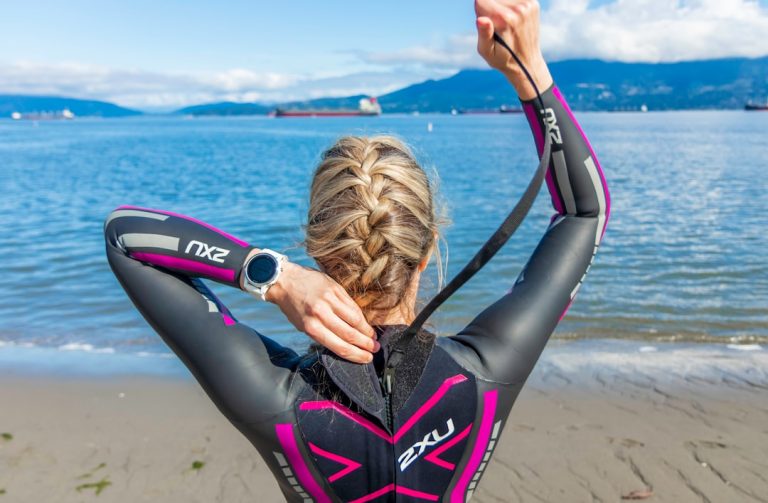
Whatever you wear needs to survive the swim, transition, and bike without changing — you’re not stopping to swap kit mid-race. A tri suit with a built-in shelf bra or compression panel works well for shorter, lower-support needs; if you need more structure than a tri suit’s built-in support provides, wearing a proper sports bra underneath your tri suit (tested in training first) is the safer route for longer, higher-impact races. Check the fit specifically against your wetsuit’s zip line and shoulder seams — a bra strap or band sitting exactly where the wetsuit rubs is a chafing problem you’ll only discover mid-swim.
Fit Checkpoints
- The band should sit snug and level all the way round without riding up at the back — most of the support should come from the band, not the straps.
- Straps shouldn’t dig in or slip during arm movement; adjustable straps let you fine-tune this after washing, since fabric stretches over time.
- No rubbing at the underarm, sternum, or shoulder seams over a full training brick — anything that feels fine for 20 minutes can still chafe badly by hour two.
- Moisture-wicking fabric matters more here than almost anywhere else in your kit, given three disciplines’ worth of sweat and open-water exposure.
Buying Tips
- Never debut new kit on race day — test any new sports bra or tri suit combination on a full brick session first.
- Replace a regularly-used sports bra every 6-12 months of consistent training; elastic support degrades well before the fabric looks worn.
- If you’re between sizes, size down on the band and up on the cup for a high-impact bra rather than the reverse.