How to Get Faster in Open Water: 7 Proven Triathlon Tips
Getting faster in open water is one of the most effective ways to improve your triathlon performance without spending money on new gear. Unlike pool swimming, open water rewards tactical awareness, efficient sighting, and the ability to hold pace in unpredictable conditions. Here are seven proven techniques to help you exit the water ahead of your rivals.
1. Fix Your Sighting Frequency
Most triathletes sight every 4–6 strokes, which creates significant drag and breaks their stroke rhythm. Work to extend your sighting interval to every 10–12 strokes by choosing larger, more stable landmarks — a church spire, a hill, the far shoreline. The fewer times you lift your head, the more distance you cover per stroke cycle.
2. Use Draft Swimming Strategically
Swimming in someone’s slipstream can reduce your energy cost by 18–25%, according to research. The optimal draft position is directly behind the lead swimmer’s feet — close enough to feel the turbulence from their kick, but not so close that you are touching. Practise drafting at your open water venue with a training partner before race day.
3. Prioritise Bilateral Breathing
Breathing to both sides keeps your stroke symmetrical, reduces the tendency to veer left or right during navigation, and prepares you for race scenarios where waves or competitors force you to breathe on your non-preferred side. Practise 3-stroke bilateral breathing in every pool session, not just open water.
4. Train Your Race-Start Pace
The first 200m of a triathlon swim is the most chaotic — and often the most important for positioning. Many athletes go out too hard and spend the next 800m in damage control. Train your race-start pace specifically by doing 6×100m at race effort immediately after a short 200m easy warm-up, simulating the feeling of hard-effort swimming on a non-warmed-up body.
5. Optimise Your Wetsuit Fit
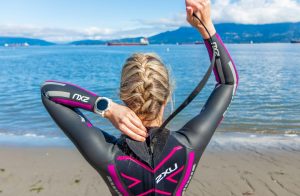
A well-fitted wetsuit improves buoyancy and body position, but only if you wear it correctly. Ensure the neoprene is pulled up fully into the armpits and the wrist seams sit correctly — an improperly fitted wetsuit restricts shoulder rotation and costs you 5–10 seconds per 100m. Complete at least two open water sessions in your wetsuit before race day to dial in the fit.
6. Do CSS Pace Work in the Pool
CSS (Critical Swim Speed) training is the most direct way to improve your open water race pace. Calculate your CSS by completing a 400m time trial and a 200m time trial, then use the pace calculator to find your aerobic threshold pace per 100m. Swim at least twice per week, with one session dedicated to CSS interval work targeting 1500–2000m of threshold-pace swimming.
7. Practise Beach and Deep Water Starts
Transitioning from running on sand to full swimming stroke, and starting from a deep water treading position, are both inefficient for most triathletes. Practise dolphin diving into shallow water — leap forward, dive headfirst, push off the bottom, and repeat until the water is chest-deep. In deep water starts, practise your first 10 strokes as a controlled surge to find clear water quickly before settling into race rhythm.
Combining these seven techniques with consistent open water practice from now until race day will deliver measurable improvements in your swim split. Focus on one change per week — small, targeted adjustments compound into significant speed gains across a full season.