
Open Water Fartlek Swim: Speed Play Session
Session Overview
Open water fartlek swimming replaces the rigid interval structure of pool training with unstructured, responsive speed play in a natural environment. Rather than following fixed distances and rest intervals, you surge based on landmarks, buoys, or feel — accelerating for 30–60 seconds, easing off, then surging again. This builds race instincts, improves your ability to accelerate and recover mid-swim, and develops the pace awareness that makes the difference in mass-start open water racing. It’s also genuinely more enjoyable than grinding out repeat lengths in a pool.
What You’ll Need
- Open water venue (lake, reservoir, or sheltered coastal area — avoid strong currents or tidal waters for fartlek training)
- Wetsuit if water temperature is below 18°C
- Tow float (recommended for solo open water swimming safety)
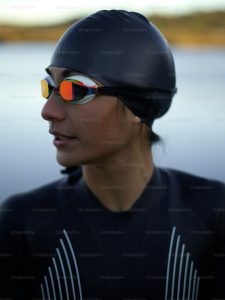
- Swim cap and goggles
- A swim buddy or swim group (strongly recommended for open water safety)
Warm-Up (10 minutes)
Enter the water gradually and begin with 5–8 minutes of steady, easy freestyle to acclimatise to the temperature and get your breathing under control. Focus on long strokes and breathing every three strokes. Include three or four sighting repetitions — lifting your head to spot a landmark — as part of the warm-up to reinforce open water technique before the intensity increases.
Main Set
Swim continuously for 25–30 minutes using landmarks, buoys, or personal feel to guide your efforts. There is no formal structure — the goal is instinctive pace variation.
- Surge 1: When you pass a buoy or reach a chosen landmark, accelerate hard for 30–45 seconds at roughly 90% effort. Then settle back to comfortable cruise pace and recover.
- Cruise periods: Easy, aerobic swimming between surges. Use this to focus on technique — high elbow catch, hip rotation, bilateral breathing — while your heart rate drops.
- Surge 2 onwards: Repeat surges every 2–4 minutes throughout the main set. Vary surge duration — some 20-second explosive efforts, some 60-second sustained pushes. Follow your instincts rather than a watch.
- Final 5 minutes: Gradually ease off the surges and swim at a comfortable aerobic pace to begin the transition into cool-down.
Cool-Down (5 minutes)
Swim easy back towards your exit point, using backstroke or relaxed freestyle. Focus on your breathing rhythm and allow your heart rate to settle. Exit the water calmly and begin a brief dryland stretch of your shoulders and upper back.
Coaching Notes
- Open water fartlek is best added to your programme from late spring through early autumn when open water venues are accessible and water temperature is safe. It complements, rather than replaces, structured pool interval work.
- Sight frequently during all surges — going hard in a straight line is significantly more effective than going hard and swimming off course. Surge, sight, surge.
- If you’re new to open water swimming, complete two or three acclimatisation sessions in calmer conditions before attempting fartlek pace work. Open water demands more focus than pool training, and adding intensity before you’re comfortable in the environment is counterproductive.
- RPE during surges should feel like 8–9/10. Recovery cruise pace should drop to 5–6/10. The contrast between effort levels is what drives the training adaptation.
You Might Also Like
Training at your own risk. The information provided is for general guidance only and is not a substitute for professional medical advice. Please consult a doctor before starting any new exercise programme, especially if you have any pre-existing health conditions.