

Track 1500m Time Trial Run Session
Session Overview
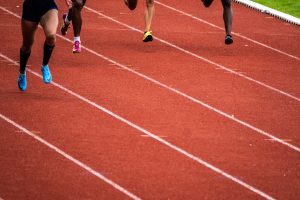
A 1500m time trial on the track is one of the most useful run benchmarks available to triathletes — short enough to push at maximal effort, long enough to require real pacing discipline. The 1500m is directly relevant to triathlon because it mirrors the run leg of a sprint triathlon at speed, and the pace data it generates anchors your CSS zones, threshold pace, and race pace targets. This session includes a technical drill component before the time trial to prime your running economy and reduce injury risk.
What You’ll Need
- Access to a 400m athletics track
- GPS watch or track distance markers (note: GPS can be inaccurate on small tracks — use track markers where possible)
- Light race shoes or training flats
- Optional: spikes for athletes who are familiar with track racing
Warm-Up (15 minutes)
Begin with 10 minutes of easy jogging around the track. Then complete a drill circuit (1 x 80m each): high knees, butt kicks, A-skips, B-skips, lateral shuffles. Finish with 3 x 80m strides at 5K effort — fast but controlled — with a full walk recovery between each stride. Shake out your legs before stepping to the start line.
Main Set
The 1500m time trial is 3¾ laps of a 400m track. Pace it as follows: the first lap should feel controlled — you’ll be tempted to go out too fast, especially on a track. Hold back slightly through the first 400m. Build gradually through laps 2 and 3, and empty the tank in the final 300m.
- 1500m time trial — single maximal effort, paced evenly to slightly negative split. Record your finishing time.
- Target pace guidance: aim for the first 400m to be 2–3 seconds slower per lap than your target average lap time. Use the final lap to make up any deficit and push to the line.
- After a 10-minute full recovery (walk and easy jog), complete 3 x 200m at slightly faster than your 1500m average pace. 3-minute recovery between each. This develops the top-end leg speed that supports strong run-off-the-bike performance.
Cool-Down (10 minutes)
Easy jog for 8 minutes followed by 2 minutes of walking. Record your 1500m time and split data in your training log — this is a benchmark session and the value compounds when you repeat it every 4–6 weeks to track fitness progression. Static stretch quads, calves, and hip flexors after.
Coaching Notes
- Your 1500m time predicts your 5K pace well: multiply your 1500m time by approximately 3.5 to estimate your 5K capability. A 5:30 1500m suggests roughly a 19-minute 5K.
- Don’t attempt this session on fatigued legs. It requires genuine maximal effort to produce useful benchmark data — completing it half-hearted gives you misleading results.
- Easier variation for runners who haven’t done track work before: replace the all-out 1500m TT with 3 x 500m at 5K race effort with 3 minutes recovery. This introduces track pacing without the pressure of a single maximal effort.
- Harder variation: complete the 1500m TT twice with 15 minutes full recovery between. The second TT at near-identical pace to the first is a strong indicator of aerobic fitness and recovery capacity.
You Might Also Like

Training at your own risk. The information provided is for general guidance only and is not a substitute for professional medical advice. Please consult a doctor before starting any new exercise programme, especially if you have any pre-existing health conditions.