

DPS Ladder: Swim Efficiency Session
Session Overview
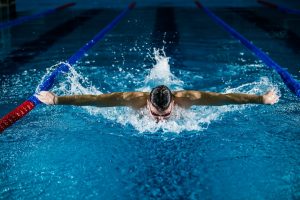
Distance per stroke (DPS) is exactly what it sounds like — how far you travel per arm cycle — and it’s a cleaner isolated measure of stroke efficiency than SWOLF, since it strips out the time component entirely and just counts strokes. This ladder session trains you to hold form at progressively lower stroke counts, which is the single biggest lever most age-group triathletes have for swimming faster without swimming harder.
What You’ll Need
- Access to a 25m pool (this session is built around 25m lengths for easy stroke counting)
- A pace clock or watch for rest intervals
- Optional: a swim watch with stroke count tracking to cross-check your own counting
Warm-Up (10 minutes)
400m easy freestyle, mixing in 4x50m drill (catch-up or fingertip drag) on 15 seconds rest to prime stroke awareness before the main set starts.
Main Set
Establish your baseline stroke count on an easy 25m first, then work the ladder below. The goal each round is to swim the same 25m distance in fewer strokes than your baseline while keeping the pace roughly consistent — you’re lengthening the stroke, not just slowing down and gliding.
- 1x25m easy — count your strokes, this is your baseline (e.g. 18 strokes)
- 4x25m aiming for baseline minus 1 stroke, 20 seconds rest
- 4x25m aiming for baseline minus 2 strokes, 20 seconds rest
- 4x25m aiming for baseline minus 3 strokes (or your practical minimum), 25 seconds rest
- 4x50m holding your best sustainable low stroke count from the ladder above, 30 seconds rest
Cool-Down (10 minutes)
200m easy mixed stroke, deliberately letting stroke count rise back to normal — the point of the cool-down here is recovery, not maintaining the technical focus.
Coaching Notes
- Reducing stroke count without slowing down means each stroke has to generate more propulsion — focus on a full catch and finish rather than just reaching further at the front, which often just adds a glide phase and slows you down
- Common mistake: dropping stroke count by over-gliding. If your 25m time balloons to hit a lower count, you’ve lost efficiency, not gained it — track both numbers together
- Scaling: beginners should focus on the first two ladder steps only and prioritise consistent technique over chasing the lowest possible count
- Track your baseline count over months, not sessions — a genuine efficiency gain shows up as your easy-swim stroke count trending down over a training block
You Might Also Like



Training at your own risk. The information provided is for general guidance only and is not a substitute for professional medical advice. Please consult a doctor before starting any new exercise programme, especially if you have any pre-existing health conditions.