
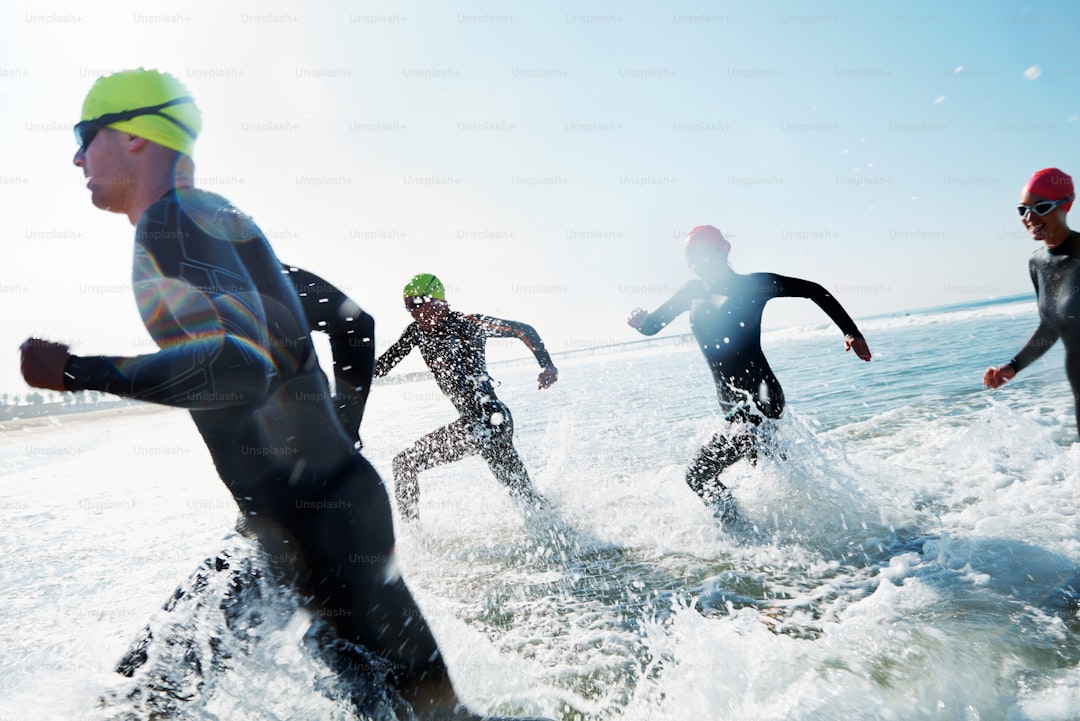
Open Water Mass Start Practice: Racing from the Gun
Session Overview
This 45-minute open water session simulates the chaos and contact of a triathlon mass start. You will practise positioning, initial sprint pace, and the transition to your sustainable race pace — the skills that can save you two to three minutes in a real race without any increase in fitness.
What You’ll Need
- Wetsuit (or swimskin if non-wetsuit legal conditions)
- Open water goggles with a tinted lens for sighting
- Bright swim cap — wear two if the water is cold (one silicone over one latex)
- Tow float or safety buoy (required at most UK open water venues)
- Two or three training partners ideally — mass start practice is most effective with contact
Warm-Up (10 minutes)
Swim 400m easy, focusing on acclimatising to the water temperature and settling your breathing. Include 4 x 15-stroke sighting drills — lift your eyes forward to a fixed point every 10–15 strokes. Finish with 4 x 25m at 80% effort to prime your system for the harder work ahead.
Main Set
The main set replicates the key phases of an open water race start: explosive sprint from stationary, physical contact management, and controlled transition to race pace. Rest fully (2–3 minutes of easy swimming) between repetitions so each start is executed at full effort.
- Set 1: 3 x 50m race-start sprints from stationary — push to 95% effort for the first 10 strokes, then ease to 85% for the remaining distance. 90 seconds rest between efforts.
- Set 2: 2 x 200m continuous — start at sprint pace, settle to threshold pace after 50m and hold. Practise sighting every 8 strokes. 2 minutes rest between efforts.
- Set 3: 1 x 400m race simulation — start with partners if available, maintain race pace throughout, and practise drafting behind another swimmer for at least 200m of the effort.
Cool-Down (5 minutes)
Swim 200m easy backstroke or a relaxed mix of strokes to flush lactic acid from the shoulders and chest. Focus on long, slow breaths and allow your heart rate to settle before exiting the water.
Coaching Notes
- Start position matters: seed yourself according to your ability — too far back means fighting through slower swimmers; too far forward means getting swum over by faster ones
- Expect contact in a mass start — keep your stroke compact and your elbows wide to hold your lane
- Sighting frequency in the first 100m should be every 6–8 strokes; reduce to every 12–15 once settled into your rhythm
- To make this easier: reduce sprint efforts to 2 x 50m and the simulation to 200m; to make it harder, add a fourth 400m race pace effort without rest
- RPE targets: sprint efforts 9/10; 200m efforts 8/10; simulation 7–8/10
You Might Also Like



Training at your own risk. The information provided is for general guidance only and is not a substitute for professional medical advice. Please consult a doctor before starting any new exercise programme, especially if you have any pre-existing health conditions.