
Open Water Beach Entry and Exit Drills
Session Overview
This 40-minute session hones three race-critical skills: explosive beach entry, efficient dolphin diving in shallow water, and a fast, upright beach exit and run to T1. Practising these transitions can save you 10–30 seconds on race day and reduces anxiety at the swim start.
What You’ll Need
- Wetsuit (if water is below 18°C)
- Goggles and swim cap
- Sandy or gently sloping beach entry (shallow lake or open water venue)
- Watch or timing device (optional)
Warm-Up (8 minutes)
Walk into the water to waist depth, then swim easy for 200m at Zone 1. Exit, walk back along the shore, and repeat twice to acclimatise to the water temperature. Focus on relaxed breathing and body awareness in the open water environment.
Main Set
Work through three drill blocks with short rest between efforts. Focus on efficient technique over speed — you’re building muscle memory, not racing.
- Beach entry drills: 6 × sprint run to waist depth then dolphin dive forward, 30 seconds rest. Dive hands-first, skimming the bottom aggressively.
- Dolphin dive sequence: 4 × 10 continuous dolphin dives along a 20m shallow stretch, 45 seconds rest. Time each set to track improvement.
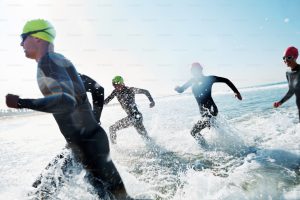
- Exit and transition run: 6 × full-speed swim 50m then beach exit + 20m run, 60 seconds rest. Remove goggles and swim cap as you exit; drive knees high through shallow water.
Cool-Down (5 minutes)
Swim 200m easy at Zone 1, focusing on long, slow strokes. Walk out calmly and stretch your calves and hip flexors, which will have worked hard during the run-in and exit efforts.
Coaching Notes
- Dolphin dives are most effective in water between ankle and chest depth — once chest-deep, start swimming immediately.
- On the exit, drive your knees high and lean slightly forward to fight the drag of shallow water.
- Beginners can halve the sets and focus purely on the exit run technique before adding dolphin dives.
- Target RPE 6–7 on sprint exit efforts; rest effort should feel easy at RPE 2–3.
You Might Also Like
Training at your own risk. The information provided is for general guidance only and is not a substitute for professional medical advice. Please consult a doctor before starting any new exercise programme, especially if you have any pre-existing health conditions.